
Last updated
How many restrooms does a marathon need?
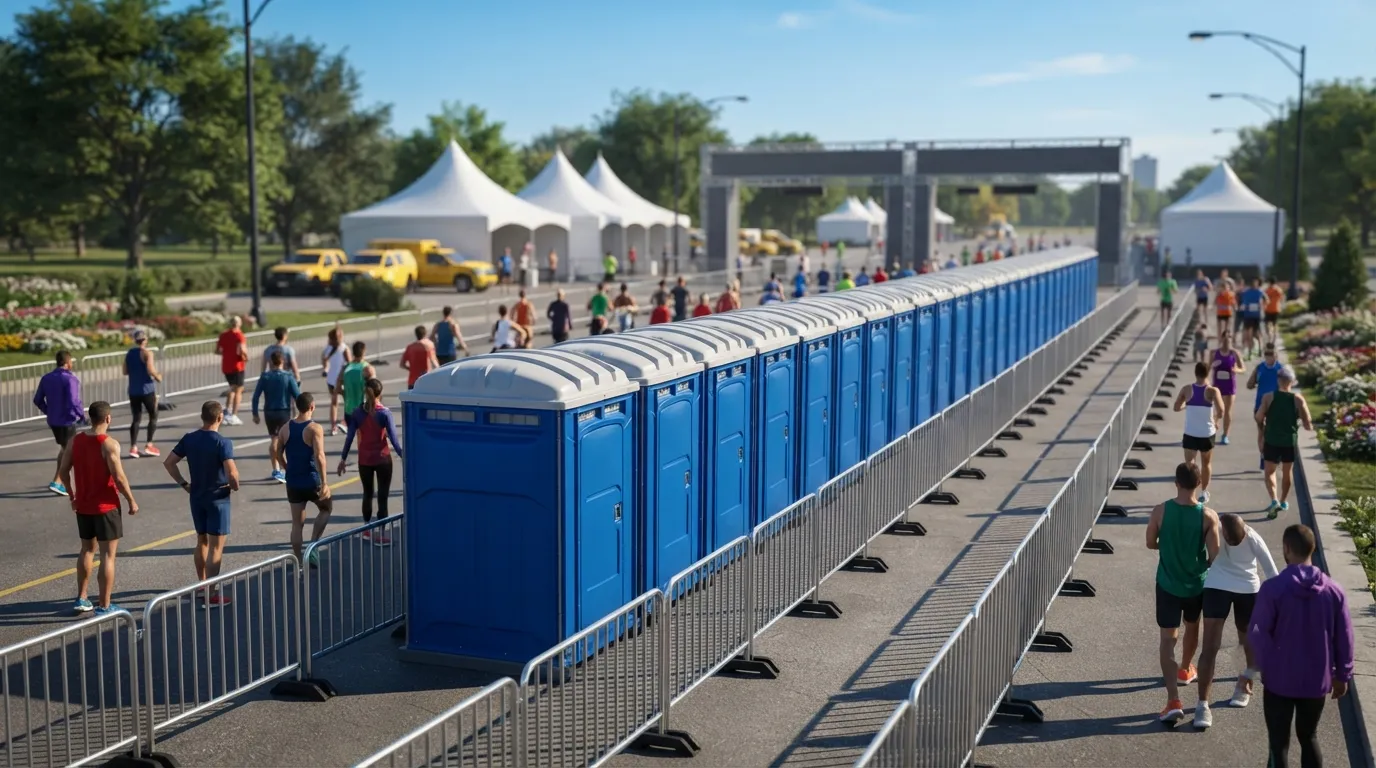
Start with the corral. A 1,500 runner field wants a real cluster at the start line, not two units off to the side, because that's where the bottleneck happens before the gun. Standard portable toilet rental units work fine here, and OSHA 1926.51(c) is a reasonable baseline even though it's written for job sites, since it scales facility counts against headcount the same way race organizers should. Add units at every aid station past mile 3, since runners who started together are now spread over miles of course. Finish line demand spikes hard for about 90 minutes as waves of finishers hydrate and wait for family. Don't skip ADA accessible porta potty units either. ADA Standards section 213.2 requires at least 5 percent of a cluster to be accessible, never fewer than one, and races draw wheelchair participants and spectators who need that unit at the start and the finish both. If your course runs through South Bend and touches Notre Dame, 3.0 miles northeast, plan a station there too, since that stretch pulls its own crowd. Use our how many porta potties do I need guide to run the math against your actual bib count before you book.
What restroom setup works best for a race weekend?
Weekend races run on a different clock than a weekday job site, and pricing reflects that. A standard unit rented for the weekend runs in the 125 to 400 dollar band, while an ADA unit for the same weekend lands between 199 and 300. Larger races with hospitality tents or VIP areas often add a deluxe flushable porta potty or a restroom trailer rental near the finish line, where sponsors and staff expect something closer to a real bathroom. Delivery timing matters more for races than for construction sites: you want units placed and serviced before runners arrive at dawn, which means confirming a delivery window the day before.
| unit | weekend price |
|---|---|
| standard | 125 to 400 |
| ada | 199 to 300 |
| dumpster | 390 to 497 |
Course support isn't just toilets. Timing tents and finish-line broadcast gear often need power, and that's where a temporary power pole comes in. If your finish line setup calls for a pole-mounted service, ask your provider how to brace a temporary power pole before race morning: it needs a stable base, guy-wires at two points minimum set away from the runner lanes, and a clear load path away from the corral so nobody clips a line during a sprint finish. Pair it with a light tower rental if your race starts before sunrise, and route both away from crowd control barrier rental lines so course marshals aren't tripping cable.
Where should restrooms go on a race course?
Placement follows the runners, not the parking lot. Put your heaviest cluster at the start corral, a second cluster at the finish, and single units or pairs at each aid station between. A roll-off clearance rule applies here too: any roll-off dumpster rental staged for post-race cleanup needs about 60 feet of straight clearance behind the truck, so keep that zone clear of barricades or vendor tents. Ground surface matters for ADA units specifically. ADA Standards section 302.1 calls for stable, firm, slip-resistant surfaces, which rules out soft turf or gravel that shifts under a wheelchair. Aim for asphalt, packed gravel, or a leveling mat under any accessible unit. Our porta potty placement guide covers ground prep in more detail. If your race crosses into Mishawaka, 5.9 miles east, or routes near Elkhart at 16.6 miles east, coordinate placement with both jurisdictions since courses that cross city lines sometimes need separate delivery drops. For hand cleanup near food and water stations, add a handwashing station rental or two, since ANSI/PSAI Z4.3 treats one service visit per week as the baseline interval for units serving up to 10 users over a 40 hour week, and race day traffic will blow past that fast, so plan for a same-day service call if your event runs long. Temporary fencing helps too. A temporary fence rental keeps spectators off the restroom queue lines near the finish.
How far in advance should I book race restrooms?
Book as soon as your course map and runner count are set, ideally 60 to 90 days out for a marathon-sized field. Weekend demand across South Bend fills fast during race season, and locking your count early avoids last-minute substitutions on unit type.
Do marathons need ADA-accessible restrooms?
Yes. ADA Standards section 213.2 requires at least 5 percent of a portable toilet cluster to be accessible, with a minimum of one unit, placed at both the start and finish areas where participants and spectators gather.
How many aid stations need their own restrooms?
Any aid station past mile 3 should have at least one unit, since runners are spread out by then and can't backtrack to the start corral. Longer courses with multiple stations need units at each one.
What size crew handles restroom service during the race?
Service timing depends on runner count and event length. High-traffic finish lines with waves of finishers over 90 minutes need a mid-event service check, not just a pre-race and post-race visit.
Can I get restrooms delivered the morning of the race?
Early morning delivery works if it's confirmed in advance. Request a quote with your exact start time so delivery lands before runners arrive at the corral, not during warmups.
Next step
Get a delivery date
Tell us the address, the dates and the headcount. We size the order and confirm the route.